Wednesday, 24 June 2009
Site Map for The Ferriter Gathering
View Ferriter Family Gathering 2009 in a larger map
O.K., What you see here is the Google Earth satellite view of the Gathering Place, with key features indicated. As noted, there is camping, nature walks, a swimming and fishing pond, a natural spring that ultimately flows into the Mississippi, plenty of parking, and a big tent for the presentations. Of course, there is much more! Pull out on the shot, and you will see, at roughly equidistant plases east and west, the Green Frog Bar, and St. Patrick's Church. We live in balance here.

Tuesday, 2 June 2009
Ferriters of Long Ago
We all have pretty clear ideas or notions as to what our ancestors were up to during the past 150 years or so. This is true for those who stayed in Ireland as well as the immigrant families. Family stories, oral traditions, old papers and photographs all serve to support this knowledge and history, within our respective lines. But what about those who lived long ago?
What was life like for the Ferriter family during the long years spent at home on the Dingle Peninsula in County Kerry? This is a picture much less clearly painted for most of us.
There are periods wherein documentary data for the Ferriter Family is very sketchy. One such interval of time is the 15th Century, or that period extending from 1400 – 1500. We do know something about life in Ireland at large during the period cited, even life as far “beyond the Pale” as that enjoyed by the Ferriter Family, living at the edge of the territories controlled by the Geraldine Earls of Desmond, and their lesser House, that of the Knight of Kerry. The sources of this data include Irish writings of the period, documentary records as kept by the Anglo-Irish within the Pale, contemporary accounts of travelers, and songs and poetry that have survived.

Traditional and Anglicized Irish Feasting, c1500
From this information, a sketch may be drawn of what the lifestyles and occupations of Ferriter families in far West Kerry were most likely like. Together with the known attributes of life and activities during these times, we can do a certain amount of forensic reconstruction, by assessing what the local economy consisted of, who trading partners might have been, and what the family’s relationships with both the indigenous Irish and the Geraldines probably were.
While the very early Ferriters have been cited as filling the niche of “knights of the shire” within the Norman feudal system put in place by the DeMarais family, and their FitzGerald successors, the notion of “knight” as it pertained to West Kerry in 1400 must be clarified. The Ferriters were never “knighted” in the modern sense, or even in the English sense…they were “knights” in that they held title to lands in response to certain services and rents owed to their “liege lord”, or next individual up on the feudal hierarchy. They had considerable legal authority over those who dwelt upon their land, and no doubt regarded themselves as the property owners.
The men of the family did not ride armored horses, dress in armor themselves, joust, or do other “knightly” things. They would however, be required to serve as soldiers under the colors of the FitzGerald family. The lead man of the family, An Fearitearach, (pronounced An Ferr – tear - och), or “The Ferriter” doubtless regarded himself as a knight, since he provided scutage, or knights service in military fashion, when called upon. He probably owned chain mail, and maintained an armory with swords and pikes sufficient to arm the men that followed him or his designee off to serve alongside other FitzGerald tributaries.
The Ferriters had come to the land as soldiers and adventurers. The land assigned or granted to them by the local authority was not prime agricultural land. In the 15th century, (prior to the introduction of the potato), this land would have been sparsely populated, in general only supporting the population that could be fed from the small farms and the sea. Then, as today, Ferriter lands embraced steeply sloping grasslands, rockbound shorelines, stony mountains, and marshland, along with several coves suitable for anchoring and beaching boats. These lands included several individual townlands, each with a concentration of families, many of which were descended from the original Gaelic stock, with lines of descent far pre-dating the Norman incursion.
With the land offering little beyond subsistence farming and pasturage, there should be little doubt that the family’s interest would turn seaward. The rights to the immediate offshore fisheries were doubtless part of their fiefdom, as were the Blasket Islands, from an early period.
As early as the century preceding that under discussion, The Ferriter had caused to be erected stone forts and fighting positions of various sorts. Like their close neighbors, the FitzGerald Kerry family (the Knight of Kerry), the Ferriters built a fortification on the remains of an earlier fortification. Such building on earlier fortified sites was common practice amongst the Normans, as the sites already fortified were often the most strategic, and the earlier fort would be a handy source for building materials.
Whereas the FitzGeralds built a bit inland, upon the remains of a ring fort attributed to the O’Falvey family, the Ferriters built on the site of a Gaelic promontory fort, right at the edge of the sea. The location of this structure speaks to the focus of the Ferriter Family upon the ocean.
Ancient Stone Hut, Ballyferriter
Life was no doubt difficult at times. For individual family units, loss of a breadwinner to the sea or to battle would place them in a position of dependency upon the extended family. One might imagine a paternal system wherein some provision was made to assist those most needy – the widows, orphaned children, and the deserving aged.
Lesser lines of the Ferriters would expect little or no inheritance, and be challenged to provide for their families.
As the Norman order, which seems to have been fairly strictly patrilineal and patrimonial began breaking down in the 14th century; Norman outposts beyond the Pale began adopting Gaelic notions of family, ownership, and law. Quite likely by the 1400s in Ferriter’s Town, some sort of shared ownership and community effort to the common good was in play, and that the extended family looked out for their own.


1759
NOTE: References and citations for source material utilized in this essay are available from the writer.
What was life like for the Ferriter family during the long years spent at home on the Dingle Peninsula in County Kerry? This is a picture much less clearly painted for most of us.
There are periods wherein documentary data for the Ferriter Family is very sketchy. One such interval of time is the 15th Century, or that period extending from 1400 – 1500. We do know something about life in Ireland at large during the period cited, even life as far “beyond the Pale” as that enjoyed by the Ferriter Family, living at the edge of the territories controlled by the Geraldine Earls of Desmond, and their lesser House, that of the Knight of Kerry. The sources of this data include Irish writings of the period, documentary records as kept by the Anglo-Irish within the Pale, contemporary accounts of travelers, and songs and poetry that have survived.

Traditional and Anglicized Irish Feasting, c1500
From this information, a sketch may be drawn of what the lifestyles and occupations of Ferriter families in far West Kerry were most likely like. Together with the known attributes of life and activities during these times, we can do a certain amount of forensic reconstruction, by assessing what the local economy consisted of, who trading partners might have been, and what the family’s relationships with both the indigenous Irish and the Geraldines probably were.
While the very early Ferriters have been cited as filling the niche of “knights of the shire” within the Norman feudal system put in place by the DeMarais family, and their FitzGerald successors, the notion of “knight” as it pertained to West Kerry in 1400 must be clarified. The Ferriters were never “knighted” in the modern sense, or even in the English sense…they were “knights” in that they held title to lands in response to certain services and rents owed to their “liege lord”, or next individual up on the feudal hierarchy. They had considerable legal authority over those who dwelt upon their land, and no doubt regarded themselves as the property owners.
The men of the family did not ride armored horses, dress in armor themselves, joust, or do other “knightly” things. They would however, be required to serve as soldiers under the colors of the FitzGerald family. The lead man of the family, An Fearitearach, (pronounced An Ferr – tear - och), or “The Ferriter” doubtless regarded himself as a knight, since he provided scutage, or knights service in military fashion, when called upon. He probably owned chain mail, and maintained an armory with swords and pikes sufficient to arm the men that followed him or his designee off to serve alongside other FitzGerald tributaries.
The Ferriters had come to the land as soldiers and adventurers. The land assigned or granted to them by the local authority was not prime agricultural land. In the 15th century, (prior to the introduction of the potato), this land would have been sparsely populated, in general only supporting the population that could be fed from the small farms and the sea. Then, as today, Ferriter lands embraced steeply sloping grasslands, rockbound shorelines, stony mountains, and marshland, along with several coves suitable for anchoring and beaching boats. These lands included several individual townlands, each with a concentration of families, many of which were descended from the original Gaelic stock, with lines of descent far pre-dating the Norman incursion.
With the land offering little beyond subsistence farming and pasturage, there should be little doubt that the family’s interest would turn seaward. The rights to the immediate offshore fisheries were doubtless part of their fiefdom, as were the Blasket Islands, from an early period.
As early as the century preceding that under discussion, The Ferriter had caused to be erected stone forts and fighting positions of various sorts. Like their close neighbors, the FitzGerald Kerry family (the Knight of Kerry), the Ferriters built a fortification on the remains of an earlier fortification. Such building on earlier fortified sites was common practice amongst the Normans, as the sites already fortified were often the most strategic, and the earlier fort would be a handy source for building materials.
Whereas the FitzGeralds built a bit inland, upon the remains of a ring fort attributed to the O’Falvey family, the Ferriters built on the site of a Gaelic promontory fort, right at the edge of the sea. The location of this structure speaks to the focus of the Ferriter Family upon the ocean.
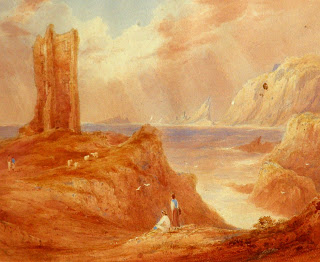 1825
1825
So what did these Ferriter men and women do on any given day? First, understand that by the mid 1400s, Ferriters had resided upon this land for a couple of hundred years. An estimate as to how many family members there were at that time can be made by examining the growth of the Ferriter name between 1650 and 1850, as these dates bracket a similar duration of time, and embrace the growth of the family in numbers from single individuals. Extending from the barest handful of souls in 1650, the Ferriter Family grew to something like 100 people by the time that the famine came. Discounting the introduction of the potato, which allowed displaced tenants farther west to eke out a living on the poor ground near Ferriter’s Town, nutrition and sanitation were in fact probably better from 1250 -1450 as opposed to 1650 – 1850. On this basis, some confidence can be applied to an estimate of on the order of 100 Ferriters in the home area in 1450.
The FitzGeralds, in their several houses, were frequent practitioners of small-scale warfare. This sort of skirmishing with adjacent lords and chieftains persisted throughout the 1400s. As The Ferriter had an obligation to provide men, both mounted and foot, and weapons, as a part of his entitlement to land, participation of Ferriter men in these many conflicts is again a certainty. That this cost the family in terms of men killed and wounded can also be assumed, but through the 1400s, the losses would have been light. Not so in the next century, but that is a different tale altogether.
Attack on a Tower House, c1450
The Knight of Kerry, a FitzGerald who held one of the three hereditary knighthoods in Desmond, made his principal residence at Castle Rahinane, on the slope above Ventry, from 1250 through to Cromwellian times in the mid 1600s. Rahinane is a short distance (less than 7 miles), from Ballyoughtra, the townland within Dunurlin where Castle Ferriter stood, and closer yet to the site where The Ferriter’s principal residence likely stood.
Castle Rahinane
While The Ferriter would not have been on equal social footing with the titled Knight, they both paid allegiance to the Earl of Desmond. One can make probably safe assumptions that The Ferriter was close to the Knight, and that the families socialized. The lesser lines of both families no doubt intermarried from early times, as they still do today, binding the families yet closer together.
While many of the men may have had as principal employment soldiering for either FitzGerald Kerry or FitzGerald Desmond, and others may have been given tasks about the farm, many should have been available for nautical work. Nautical work probably included inshore fishing, trips to the Blaskets and beyond for deeper water fishery, light cargo transport from the cove to the deeper harbors of Smerwick or Dingle, as well as light coastwise shipping, perhaps up the bay to Tralee, and around the Shannon mouth and upstream to Limerick. Cargos would have included livestock, fish, local crafts, perhaps wax and honey in season, salt, and passengers.
What sort of craft would have been used in these activities? The sea going boats of recent history provide strong clues. First, the traditional curragh, constructed with lightweight ribs and stiffened via application of a stretched outer covering of leather. These vessels remain in use in West Kerry, and elsewhere along the western coast of Ireland. The fabled voyage of the missionary Saint Breandan is said to have involved such a boat – stout enough to transit the Atlantic, and make landfall in the New World, hundreds of years before Columbus.
Up from the curragh, we have the famed Galway Bay “hooker” a lateen rigged open hulled workboat that also remained in service until recent times, famous for her black sails.
The probability that Ferriters deployed similar vessels in pursuit of the sea’s bounty, and as wage earners in the transport of goods and people is very high.
The fore mentioned seaside fort probably served a base for nautical activities, amongst other things. Castle Ferriter would have been great place to secure valuable items like cleats, hawsers, sails, oars, nets and lines. In addition to being a storehouse, the structure, with it’s massively thick walls, and apertures for weapons would have been an outstanding defensive position. In addition to all of these fine qualities, the tower also would have been an excellent signal tower or light house, which may help explain why “Castle Sybil” and “Castle Ferriter” (different names for the same place) remained on so many maps of Ireland for so long. 1605
1605
Trade with Spain, and to a lesser extent France and England was also a feature of West Kerry life during the 1400s. This activity required larger vessels than the hooker, but probably not much different in shape or design. That ships left Dingle for these far away places is known. That Ferriters sailed upon these ships, perhaps as crew, perhaps as captains cannot be established in fact, but can be supposed with confidence.
One might surmise that the lucrative pastimes of piracy and shipwrecking might have been partaken of from time to time. It is most certainly true that the coast of Southwestern Ireland with its wild shores and secret coves had a terrible reputation for both of these up to modern times. I may write more on that later, but not here, not now.
That Ferriter’s Town, and all the rest of Dunurlin spread across the land in small clusters of stone houses, with the occasional larger farmhouse, and with a substantial fortified messuage, or manor castle near the church at Dunurlin can be easily visualized. Stone houses, stone walls, stone mountains and stone sea cliffs – these were the physical boundaries that embraced the early Ferriters in Kerry. War, trade, and fishing were most likely the principal occupations of the Ferriter men. Their society would have swirled about these activities, with women, family, and the church near the center of this swirl.

Ancient Stone Hut, Ballyferriter
Life was no doubt difficult at times. For individual family units, loss of a breadwinner to the sea or to battle would place them in a position of dependency upon the extended family. One might imagine a paternal system wherein some provision was made to assist those most needy – the widows, orphaned children, and the deserving aged.
Lesser lines of the Ferriters would expect little or no inheritance, and be challenged to provide for their families.
As the Norman order, which seems to have been fairly strictly patrilineal and patrimonial began breaking down in the 14th century; Norman outposts beyond the Pale began adopting Gaelic notions of family, ownership, and law. Quite likely by the 1400s in Ferriter’s Town, some sort of shared ownership and community effort to the common good was in play, and that the extended family looked out for their own.

2009
This is supposition, but knowing those of use who bear the name yet today, I would think nothing less. We might be confident that Ferriters were then, much as as Ferriters are now, willing to work hard, set high goals, and to ensure that no family member is abandoned or forgotten.
This is supposition, but knowing those of use who bear the name yet today, I would think nothing less. We might be confident that Ferriters were then, much as as Ferriters are now, willing to work hard, set high goals, and to ensure that no family member is abandoned or forgotten.

1759
NOTE: References and citations for source material utilized in this essay are available from the writer.
Friday, 27 February 2009
On The Eve of a Trip to Ireland

One can wonder about the nature of “family”. Certainly shared personal experience, bonds of love, common values and bonds of place are fundamental to any acceptable definition of what constitutes a family. This explains why certain faith communities, military units, political cadres, and even work groups can attain a strong sense of being families. Sometimes these groups displace or replace blood relationship-based families in the lives of individuals.
I have written before about the unique attributes of the Ferriter Family. In this context, I am defining the family in a very broad sense – that of a group of people who share certain genetic kinship, and whose history has played out with certain common forces in play. These two elements, taken alone, are not of necessity strong bonds in our shared culture. Western Europe, and the New World extension of that has grown away from placing any premium on shared history, and the notion that distant biological or genetic kinship has value also has largely been dismissed. Nuclear families and current popular idiom have displaced extended families and heritage.
In society at large, the eclipse of the sense of extended family must be regarded as a terrible loss. The term “extended family”, has now come merely to mean, parents, grandparents, children, and sometimes aunts, uncles and first cousins, (but usually not). Many people do not even know what second or third cousins are, much less who they are.
When I study the portions of the Padraig Feiritear (1856 – 1924) Family Tree that describes the state of the Ferriter Family prior to the Irish Diaspora, I am struck with a certainty that these people not only knew of each other, but in most cases actually knew each other, and knew how they related to one another. I also have no doubt, that if everyone had stayed home, that if history had been different and whole branches of the family had not left Ireland, then this sense of understanding would have remained intact to a much greater degree than it has.
I stated that the Ferriter Family has unique attributes. One aspect of this uniqueness is our small size, numerically. Another aspect of this is our close inter-relatedness, at least in a global sense. Many of us are more closely related than 5th “cousinship”, and almost everyone seems to be closer than 7th. In terms of the world population, this is like being siblings.
Now you may have deduced that I am concerned with loss of a sense of kinship, and what might be done to remedy that. We have a gulf between the Irish and the immigrants, and we also have gulfs between immigrant branches and even between branches of the family that stayed in Ireland. Yet in our family (and this is hugely important), we all know who we all are, at least by virtue of our uncommon name.
When I am confronted by a Ferriter or Feiritear, or Firtear, or Farritor who says, “We are not related”, I simply disregard that, because I am increasingly certain that such a statement is incorrect. When I am confronted by someone who says, “I don’t regard you as a part of my family”, I feel a sharp pain, because in this I see clear evidence of our shared loss, as an extended family.
We are entering a period in history of increased distress and turmoil, on many levels. In the hierarchy of loyalties that has developed through my life, “Family” has been gradually ascendant. During any time of disorder and confusion, we should be able to look both at our immediate, nuclear families as a source of stability, but also towards our extended families. I am not speaking now about sharing resources or communal efforts, but about something a bit deeper, and certainly easier to sustain – simply the sense of being a part of something larger, a larger family that has a degree of self – awareness, and a common basis for communication as a result.
Being a Ferriter, however you may choose to spell it, may never transcend loyalties of politics or faith, although for some it might. “Ferriterness” may vary by degree between individuals. For all of us, a benefit, and an increase in the fabric and texture of our lives is available if we come to awareness that we are, in fact, one family.
So, I have made all of these statements when I am five days away from traveling to an island whereupon I was not born, and have no knowledge of save through tales, books and the accounts of others. For all that, I have always tried to keep a clear eyed and realistic vision of the place, and for all of that, I do sense an affinity for this place, and for the people who have made their lives their, through hardship and famine, and who never left.
This should be an interesting trip.
Tuesday, 6 January 2009
1969
When this blog began, the thought was to provide a forum for individual posting of Ferriter Family histories, anecdotes, and tales that might prove meaningful or entertaining for the rest of the family to read. I’m placing this little piece into the entertainment category, although it is good history as well.
Note: The essay was originally written in 1993, fifteen years ago, but already then nearly 25 years after the fact. Most of the memories remain sharp in my mind to this day, but I’m thinking that back in ’93, these same memories were just a bit clearer.
I n Which Young George Goes to Woodstock
March, 1993 Beloit Wisconsin.
In memory, the passage of time often becomes blurred, compressed, or accelerated. In my case, the distance between the Now of 1993 and the eventful summer of 1969 scarcely seems like nearly a quarter of a century. The purpose of this affidavit becomes the documentation of my impressions, perceptions, and memories of what seem even today like such recent activities.
1969 was a pivotal year in the history of the 20th century United States: Richard Nixon was inaugurated as president, men arrived on the moon, troop levels in Viet Nam reached the high water mark, the Draft Lottery was implemented, and what even then was referred to as the “Counter-Culture” was in high gear.
Rock and Roll as a stand-alone musical art form was scarcely 15 years old, yet in those few years had traversed a range extending from Buddy Holly to Jimi Hendrix. What seemd then like a sea change was underway: Rock and Roll music had come to be both a symbol and the voice of a wildly free youth – the youth of children who lived in what was by far the wealthiest nation on earth, children of the Victors of World War II, Children who were blessed by time and circumstance like no others before or since. Children blessed by time, free to attend school, to be creative, and to have fun like no one ever had fun before.
The Counter-Culture was a manifestation of this freedom, coupled with a sometimes violent reaction to the mainstream politics of the time, and and even more violent reaction to the prosecution of the War in Viet Nam. Music, dress, hairstyle, and for some, use of mind-altering drugs were all Counter-Culture related.
I graduated from High School in 1969. Having been born in December 1951, I was still 17 at graduation. My future plans were hazy: I knew that I would be attending the University of New Hampshire in the Fall, but that was then, and Summer was Now!
After High School, my buddy Dave Hislop and I had planned a motorcycle trip to California. We departed late in June, over the protests of my father, who was convinced that we would be killed. We did survive – out and back on Route 66 and partly on the new Interstates still being built in the west. We had many adventures that are not part of this tale, and all the while, whenever we connected with anyone else of our age group, we kept hearing about the big outdoor Rock and Roll concert that would be happening later that summer.
That was Woodstock, and I first heard about in El Paso Texas, about the same time as the lunar landing, which we watched at a Laundromat there.
The word of mouth communication of Woodstock seems to be one of the most remarkable aspects of the event: I do not believe that it was advertised much outside of New York City, and possibly San Francisco, and then only in specialty newspapers , but it seemed as if everyone knew about it, at least by mid-summer. Mostly by word of mouth, it seems.
Man, I knew that I was going! Advance tickets were expensive, but word was, the gates would be open to all. All of the great music groups of the day were going to play – all of them! The concert would last as long as necessary for all of the bands to play. What a scene!
So, I went off to Woodstock – myself and my cool pals from High School. My friend Frankie Drove – his father owned a Ford dealership, and somehow he obtained the use of a brand-new LTD, loaded, which fit the five of us, plus our camping gear: Frankie, Mike, Bill, John, and myself.
We drove westward from the New Hampshire seacoast, across southern New Hampshire and southern Vermont, into New York State. The driving time would have been about five hours, but we stopped for supplies across the line in NY State. Arriving within a few miles of the concert site by early afternoon, we found all of the roads, side-roads, driveways, lawns, and available fields jammed with vehicles. We parked and walked in those last few miles, leaving Frankie, who was fearful of leaving the mint LTD unattended.
As we approached the concert, the world became a crowd, and the crowd became the dominant feature of awareness: The landscape was a sea of people, and the quietest moment filled with a vast ululation of voices.
The first act that I recall was the great Indian sitar master, Ravi Shankar. What time on the first day he played, I do not know, but it may have been late in the afternoon, or early evening. I remeber slipping through the remains of a chain link fence, and moving into the crowd, listening.
The concert was not comfortable. That first night, rain came, and mud quickly became the salient feature of the land surface for the rest of our stay.
I became separated from my friends, and explored a lot, wanting to see it all, and to know where everything was. As darkness became night, I was stupefied by a sea of lights, as the crowd lit matches and lighters during a long and humorous monolog by Arlo Guthrie. This sea of lights was repeated a number of times during the show.
That night, I slept on the ground in the woods, in the rain. Most amazingly, I was found by my friends the next morning, as the literally stumbled over me while cutting through the trees, around dawn of the second day.
Frankie had somehow contrived to bring his LTD in very close to one of the fenceline gates. The car then became our base. Since our sleeping bags were all soaked, we draped them over the car to dry, (the second day began much nicer, weather-wise), where they were stolen as we slept inside, catching up on sleep missed the night before.
During the second day, I once again spent a lot of time wandering. Two of my pals were imagined or genuine victims of the “brown acid”, and went to the medical tent, which was nearby. This was not for me, so I hiked over to the playground ( I recall a giant tripod with a flat rock suspended by ropes being used as a swing, checked out the craft fair (macrame), and finally ended up by a small pond. Throughout this odyssey, the air was alive with music as the Day Two lineup performed. Periodically, I’d just sit down and listen. (Somehow, Mountain’s “Theme From an Imaginary Western” has been embedded in my mind ever since that day).
The little pond was a refuge for a few male and female swimmers, who swam nude. It was at this pond, as I dozed under a tree, that I experienced what remains in my memory as the perfect icon of the entire event: two lovely young women came down to the shore and casually disrobed in the unselfconscious manner of children, and took a dip.
The second night had great music, (hell, all of the music was great, although the Grateful Dead had some trouble ). Creedence Clearwater, and The Who put on great shows, with young George sitting in the crowd, crouched on the mud, enjoying it all.
The third day started with Grace Slick and the Jefferson Airplane, exhorting us all to rise up and endure, and enjoy…Yet by the end of the Airplane’s set, we were talking about leaving. This was Sunday, Frankie needed to get the LTD back on the lot,, we had run out of supplies and money, and were exhausted. People were starting to leave, so we decided to go too. It looked like more rain, so we piled into the LTD, damp and filthy, and headed east.
I believe that I slept the entire way home.
When the Wagons Leave the City
For the Forest and Further On
Painted Wagons of the Morning
Dusty Roads Where They’ve Gone
Sometimes Travelin´ Through the Darkness
At the Summer Comin´ Home
Foreign Faces By the Wayside
Look As If They Hadn´t Known
All the Sad Was in Their Eyes
And the Desert That´s Dry
In a Country Town
Where the Map Was Found…
(Theme From an Imaginary Western, Leslie West/Mountain, c1969)
Afternotes, January, 2009.
In 1993, I drew a map from memory of what I recalled. Last year, I held this against an actual map of the Woodstock Concert site, and was pleased to see that my 1993 recollections had been pretty close. I’d like to think that this extends to my memories of the event in general.
I do not recall all of the music that was played while we were there. Sometimes I was walking around looking at things, sometimes I was asleep. That’s just how it was. We did not have the stamina to stay until Monday, which is when Jimi Hendrix, the last act, played.
The pictures posted are typical. I may be in them, or maybe not. I will say that they are what I saw. Aside from the professionals, there weren't mant cameras visible at Woodstock.
There were drugs and alcohol at Woodstock: Mostly marijuana, LSD and wine. Aside from the misadventures experienced by two of my friends and some others, drug use was pretty low key, albeit pervasive.
Frankie’s driving, and his getting the car to within a couple of hundred yards of the stage by the second day was amazing. Just driving through the crowds must have been an incredible hassle. I don’t think we ever thanked him for that, but walking out that third day, as beat as we were, would have been a challenge. Thanks Frankie.
Final note: As we have discussed before, members of this family whether they be Farritors, Feirtears, Ferritors, et al, are often found near the heart of things, and where the action is. I've posted this little tale as another case in point.
Note: The essay was originally written in 1993, fifteen years ago, but already then nearly 25 years after the fact. Most of the memories remain sharp in my mind to this day, but I’m thinking that back in ’93, these same memories were just a bit clearer.
I
 n Which Young George Goes to Woodstock
March, 1993 Beloit Wisconsin.
In memory, the passage of time often becomes blurred, compressed, or accelerated. In my case, the distance between the Now of 1993 and the eventful summer of 1969 scarcely seems like nearly a quarter of a century. The purpose of this affidavit becomes the documentation of my impressions, perceptions, and memories of what seem even today like such recent activities.
1969 was a pivotal year in the history of the 20th century United States: Richard Nixon was inaugurated as president, men arrived on the moon, troop levels in Viet Nam reached the high water mark, the Draft Lottery was implemented, and what even then was referred to as the “Counter-Culture” was in high gear.
Rock and Roll as a stand-alone musical art form was scarcely 15 years old, yet in those few years had traversed a range extending from Buddy Holly to Jimi Hendrix. What seemd then like a sea change was underway: Rock and Roll music had come to be both a symbol and the voice of a wildly free youth – the youth of children who lived in what was by far the wealthiest nation on earth, children of the Victors of World War II, Children who were blessed by time and circumstance like no others before or since. Children blessed by time, free to attend school, to be creative, and to have fun like no one ever had fun before.
The Counter-Culture was a manifestation of this freedom, coupled with a sometimes violent reaction to the mainstream politics of the time, and and even more violent reaction to the prosecution of the War in Viet Nam. Music, dress, hairstyle, and for some, use of mind-altering drugs were all Counter-Culture related.
I graduated from High School in 1969. Having been born in December 1951, I was still 17 at graduation. My future plans were hazy: I knew that I would be attending the University of New Hampshire in the Fall, but that was then, and Summer was Now!
After High School, my buddy Dave Hislop and I had planned a motorcycle trip to California. We departed late in June, over the protests of my father, who was convinced that we would be killed. We did survive – out and back on Route 66 and partly on the new Interstates still being built in the west. We had many adventures that are not part of this tale, and all the while, whenever we connected with anyone else of our age group, we kept hearing about the big outdoor Rock and Roll concert that would be happening later that summer.
That was Woodstock, and I first heard about in El Paso Texas, about the same time as the lunar landing, which we watched at a Laundromat there.
The word of mouth communication of Woodstock seems to be one of the most remarkable aspects of the event: I do not believe that it was advertised much outside of New York City, and possibly San Francisco, and then only in specialty newspapers , but it seemed as if everyone knew about it, at least by mid-summer. Mostly by word of mouth, it seems.
Man, I knew that I was going! Advance tickets were expensive, but word was, the gates would be open to all. All of the great music groups of the day were going to play – all of them! The concert would last as long as necessary for all of the bands to play. What a scene!
So, I went off to Woodstock – myself and my cool pals from High School. My friend Frankie Drove – his father owned a Ford dealership, and somehow he obtained the use of a brand-new LTD, loaded, which fit the five of us, plus our camping gear: Frankie, Mike, Bill, John, and myself.
We drove westward from the New Hampshire seacoast, across southern New Hampshire and southern Vermont, into New York State. The driving time would have been about five hours, but we stopped for supplies across the line in NY State. Arriving within a few miles of the concert site by early afternoon, we found all of the roads, side-roads, driveways, lawns, and available fields jammed with vehicles. We parked and walked in those last few miles, leaving Frankie, who was fearful of leaving the mint LTD unattended.
As we approached the concert, the world became a crowd, and the crowd became the dominant feature of awareness: The landscape was a sea of people, and the quietest moment filled with a vast ululation of voices.
The first act that I recall was the great Indian sitar master, Ravi Shankar. What time on the first day he played, I do not know, but it may have been late in the afternoon, or early evening. I remeber slipping through the remains of a chain link fence, and moving into the crowd, listening.
The concert was not comfortable. That first night, rain came, and mud quickly became the salient feature of the land surface for the rest of our stay.
I became separated from my friends, and explored a lot, wanting to see it all, and to know where everything was. As darkness became night, I was stupefied by a sea of lights, as the crowd lit matches and lighters during a long and humorous monolog by Arlo Guthrie. This sea of lights was repeated a number of times during the show.
That night, I slept on the ground in the woods, in the rain. Most amazingly, I was found by my friends the next morning, as the literally stumbled over me while cutting through the trees, around dawn of the second day.
Frankie had somehow contrived to bring his LTD in very close to one of the fenceline gates. The car then became our base. Since our sleeping bags were all soaked, we draped them over the car to dry, (the second day began much nicer, weather-wise), where they were stolen as we slept inside, catching up on sleep missed the night before.
During the second day, I once again spent a lot of time wandering. Two of my pals were imagined
 or genuine victims of the “brown acid”, and went to the medical tent, which was nearby. This was not for me, so I hiked over to the playground ( I recall a giant tripod with a flat rock suspended by ropes being used as a swing, checked out the craft fair (macrame), and finally ended up by a small pond. Throughout this odyssey, the air was alive with music as the Day Two lineup performed. Periodically, I’d just sit down and listen. (Somehow, Mountain’s “Theme From an Imaginary Western” has been embedded in my mind ever since that day).
The little pond was a refuge for a few male and female swimmers, who swam nude. It was at this pond, as I dozed under a tree, that I experienced what remains in my memory as the perfect icon of the entire event: two lovely young women came down to the shore and casually disrobed in the unselfconscious manner of children, and took a dip.
The second night had great music, (hell, all of the music was great, although the Grateful Dead had some trouble ). Creedence Clearwater, and The Who put on great shows, with young George sitting in the crowd, crouched on the mud, enjoying it all.
The third day started with Grace Slick and the Jefferson Airplane, exhorting us all to rise up and endure, and enjoy…Yet by the end of the Airplane’s set, we were talking about leaving. This was Sunday, Frankie needed to get the LTD back on the lot,, we had run out of supplies and money, and were exhausted. People were starting to leave, so we decided to go too. It looked like more rain, so we piled into the LTD, damp and filthy, and headed east.
I believe that I slept the entire way home.
When the Wagons Leave the City
For the Forest and Further On
Painted Wagons of the Morning
Dusty Roads Where They’ve Gone
Sometimes Travelin´ Through the Darkness
At the Summer Comin´ Home
Foreign Faces By the Wayside
Look As If They Hadn´t Known
All the Sad Was in Their Eyes
And the Desert That´s Dry
In a Country Town
Where the Map Was Found…
(Theme From an Imaginary Western, Leslie West/Mountain, c1969)
Afternotes, January, 2009.
In 1993, I drew a map from memory of what I recalled. Last year, I held this against an actual map of the Woodstock Concert site, and was pleased to see that my 1993 recollections had been pretty close. I’d like to think that this extends to my memories of the event in general.
I do not recall all of the music that was played while we were there. Sometimes I was walking around looking at things, sometimes I was asleep. That’s just how it was. We did not have the stamina to stay until Monday, which is when Jimi Hendrix, the last act, played.
The pictures posted are typical. I may be in them, or maybe not. I will say that they are what I saw. Aside from the professionals, there weren't mant cameras visible at Woodstock.
There were drugs and alcohol at Woodstock: Mostly marijuana, LSD and wine. Aside from the misadventures experienced by two of my friends and some others, drug use was pretty low key, albeit pervasive.
Frankie’s driving, and his getting the car to within a couple of hundred yards of the stage by the second day was amazing. Just driving through the crowds must have been an incredible hassle. I don’t think we ever thanked him for that, but walking out that third day, as beat as we were, would have been a challenge. Thanks Frankie.

Final note: As we have discussed before, members of this family whether they be Farritors, Feirtears, Ferritors, et al, are often found near the heart of things, and where the action is. I've posted this little tale as another case in point.
Friday, 7 November 2008
John's Story - One of the Frozen Chosin
John's Story: One of the Frozen Chosin
The background doesn’t matter so much anymore. Let it be known that soldiers and Marines found themselves battling a nearly defeated enemy in Korea, as winter, 1950 descended upon them. As the frigid cold descended from Siberia, enormous armies of Chinese also poured into the Korean mountains, intent upon destroying all of the American Forces, be they Army or Marine Corps. On the Western side of the peninsula, the U.S 8th Army was smashed, and sent reeling southward in defeat. On the eastern side of the country, a combined force of USMC and U.S. Army infantry had closed in around a large reservoir, high in the mountains. This place was called the Chosin Reservoir.
The fighting retreat by the U.S. Marines from the Chosin Reservoir back down to the sea is now understood to have been one of the greatest feats of arms of all history.
Master Sergeant John Farritor, professional marine, veteran of Guadalcanal and Iwo Jima in WWII, was serving in the force that had moved up the winding mountain road to the Chosin Reservoir, when the Chinese assault hit. The following history is his history, in his words:
The fighting retreat by the U.S. Marines from the Chosin Reservoir back down to the sea is now understood to have been one of the greatest feats of arms of all history.
Master Sergeant John Farritor, professional marine, veteran of Guadalcanal and Iwo Jima in WWII, was serving in the force that had moved up the winding mountain road to the Chosin Reservoir, when the Chinese assault hit. The following history is his history, in his words:

November/December 1950
We arrived in Yudam-Ni on November 25. Every one of the 70 miles from the sea to Yudam-Ni was washed with Marine blood, spilled by fighting Chinese.
That same night the Yudam-Ni perimeter defenses were hit and nearly overrun by wave after wave of bugle-blowing Chinese. They were repelled but at a terrible price. There were 200 dead Marines and the snow was littered with enemy dead. At 0400 in the morning the Chinese left as suddenly as they had come.
The wind blowing off the frozen reservoir had a “wind chill” factor of -75°F. As a 14-year-old on the plains of Nebraska, I remember the big storm of the winter of 1934. The snow was deep and temperature was -21°F. I rode my horse Midget with a sack of cotton seed pellets to feed isolated cows lost in the snowstorm. Here the temperature was about the same but the wind chill was the killer.
For the next three days, they held the line against repeated assaults. The cost in lives was high on both sides. The Chinese had replacements, but we didn’t. We put up tents for the wounded but there weren’t enough tents; only the most seriously wounded were tented.
In this kind of cold, the best treatment was no treatment. By cutting their clothes open, the wounded would freeze to death. Most wounds froze over and sealed themselves. The blood bubbled up as it froze, looking like pink cotton candy. The corpsmen had to wear gloves to keep their hands from freezing.
While all this was going on, the U.S. Army had its running shoes on and were heading south. They had their backs to the enemy; we Marines were facing our enemy who were all around us.
When the word went out that we were surrounded, a correspondent asked Col. “Chesty” Puller his thoughts on the matter. He replied, “We got the bastards right where we want them and they’re not going to get away.” And damn few of them did!

As the battle raged, there was no escape from the incessant mélange of bugles blaring, cries of the wounded, and calls for corpsmen, all mingled with the sounds of our weapons and the rapid fire of the Chinese machine guns.
On the 29th we started lining up for our journey to the sea. Tanks and artillery would be placed on the point and spotted at intervals throughout the convoy. My three trucks would be #16, #17, and #18 in line of march.
My trucks were loaded to the top of the bed with rations. (There were no canvas tops.) This flat space was for the wounded and frostbitten patients who were unable to walk. The battalion corpsman was assigned to my first truck.
My three trailers were for dead bodies; we started the trip with three dead Marines. One of them was from my section. He had told me one time, “If anything happens to me, I hope you will write to my mom.”
I promised him that I would. However, as we loaded his frozen body in the trailer, I thought to myself: I’ll write to his mom if I get out of here alive. I did get out and I did write to his mother.
Now back to Yudam-Ni…We had infantry in front on the sides and to the rear. Hagaru-Ri was just 14 miles away as the crow flies; however, within that 14 miles were 100,000 well-trained Chinese who had been sent here with a special mission – to wipe out the 1st Marine Division. Toktong Pass was the halfway point. On the way into Yudam-Ni, a company of Marines was left at Toktong Pass. This pass had to be held at all costs. If we lost Toktong Pass, it could very well mean that all were lost. Another battalion was ordered overland to reinforce the company at Toktong. This cross-mountain move over extremely difficult terrain, ploughing through deep snow, plus having to fight Chinese, was in itself an epic. The leader Lt. Col. Davis, received the Congressional Medal of Honor. He earned it. This “fortress” in the sky was so important that they made air drops of food and ammunition.
I said before that I had three trucks. That did not mean I rode. I walked every step of the way and I saw to it that there were no freeloaders on my trucks.
At high noon on the first of December, the first units moved out from Yudam-Ni. Three hundred yards out they were heavily engaged. This was the way it would be all the way. It took 49 hours of bloody fighting to make contact with the Marines on Toktong Pass. As many as 120 Marines were killed in that 49 hours and the distance traveled was only six miles. A convoy 14 miles long is hard to protect from small suicide squads.
Our convoy speed was about three miles an hour. There were a lot of interruptions by enemy attacks. The enemy would try to plug the road with blown-up vehicles. There were bulldozers spotted all through the convoy for the purpose of shoving broken or shot-up trucks over the side of the mountain.
At five that afternoon my section arrived in Hagaru-Ri. The end of the convoy was still 10 miles out.
The troops at Koto-Ri had set up warming tents for us new arrivals from Yudam-Ni – our first warm air in many days. It was standing room only but I didn’t hear anyone complain. Come daylight the heat goes off and we move on. The outside temperature had warmed up to -20°F.
When we arrived at Hagaru-Ri we had not slept for 10 days. If one should fall asleep in this cold he could very well freeze to death. We had to keep moving. The warming tents at Hagaru-Ri were a needed break, and in spite of the crowded conditions, our exhausted bodies demanded and got a few hours of much needed sleep.
At the crack of dawn we dragged our cold, battered bodies out to the road. Koto-Ri was next. Koto-Ri was controlled and occupied by Red Chinese. As we moved out we passed through the roadblock that had kept the Reds out of Hagaru-Ri. There were literally piles of dead Chinese. Many of them had been run over by tanks. It was a grizzly sight; it showed how hard the Marines at Hagaru-Ri had fought so that we from Yudam-Ni would have a haven to which to come.
When my part of the convoy arrived in Koto-Ri, a blinding snowstorm hit. It was so bad everything had to stop. Even the Chinese had to try to survive its onslaught. For two days we endured the blizzard. Then it cleared and the weather turned colder, which is normal. At 20 below, 15 degrees up or down rally didn’t matter.
Then we reached Sudong-Ni. This town was a welcome sight; it was at the end of the mountains and the start of the Hungnam Plain. It also meant we were only 35 miles from the sea. As we traveled along we could see the lights of Hamhung/Hungnam. We could see the lights of ships at sea. It was a beautiful sight. Seeing it meant we had survived.
We couldn’t help but think about MacArthur’s remark that the 1st Marine Division was lost and there was no way they could be rescued. We made a liar out of him. Our fighting withdrawal meant that 22,000 Marines would live to fight another day.
We arrived in Yudam-Ni on November 25. Every one of the 70 miles from the sea to Yudam-Ni was washed with Marine blood, spilled by fighting Chinese.
That same night the Yudam-Ni perimeter defenses were hit and nearly overrun by wave after wave of bugle-blowing Chinese. They were repelled but at a terrible price. There were 200 dead Marines and the snow was littered with enemy dead. At 0400 in the morning the Chinese left as suddenly as they had come.
The wind blowing off the frozen reservoir had a “wind chill” factor of -75°F. As a 14-year-old on the plains of Nebraska, I remember the big storm of the winter of 1934. The snow was deep and temperature was -21°F. I rode my horse Midget with a sack of cotton seed pellets to feed isolated cows lost in the snowstorm. Here the temperature was about the same but the wind chill was the killer.
For the next three days, they held the line against repeated assaults. The cost in lives was high on both sides. The Chinese had replacements, but we didn’t. We put up tents for the wounded but there weren’t enough tents; only the most seriously wounded were tented.
In this kind of cold, the best treatment was no treatment. By cutting their clothes open, the wounded would freeze to death. Most wounds froze over and sealed themselves. The blood bubbled up as it froze, looking like pink cotton candy. The corpsmen had to wear gloves to keep their hands from freezing.
While all this was going on, the U.S. Army had its running shoes on and were heading south. They had their backs to the enemy; we Marines were facing our enemy who were all around us.
When the word went out that we were surrounded, a correspondent asked Col. “Chesty” Puller his thoughts on the matter. He replied, “We got the bastards right where we want them and they’re not going to get away.” And damn few of them did!
As the battle raged, there was no escape from the incessant mélange of bugles blaring, cries of the wounded, and calls for corpsmen, all mingled with the sounds of our weapons and the rapid fire of the Chinese machine guns.
On the 29th we started lining up for our journey to the sea. Tanks and artillery would be placed on the point and spotted at intervals throughout the convoy. My three trucks would be #16, #17, and #18 in line of march.
My trucks were loaded to the top of the bed with rations. (There were no canvas tops.) This flat space was for the wounded and frostbitten patients who were unable to walk. The battalion corpsman was assigned to my first truck.
My three trailers were for dead bodies; we started the trip with three dead Marines. One of them was from my section. He had told me one time, “If anything happens to me, I hope you will write to my mom.”
I promised him that I would. However, as we loaded his frozen body in the trailer, I thought to myself: I’ll write to his mom if I get out of here alive. I did get out and I did write to his mother.
Now back to Yudam-Ni…We had infantry in front on the sides and to the rear. Hagaru-Ri was just 14 miles away as the crow flies; however, within that 14 miles were 100,000 well-trained Chinese who had been sent here with a special mission – to wipe out the 1st Marine Division. Toktong Pass was the halfway point. On the way into Yudam-Ni, a company of Marines was left at Toktong Pass. This pass had to be held at all costs. If we lost Toktong Pass, it could very well mean that all were lost. Another battalion was ordered overland to reinforce the company at Toktong. This cross-mountain move over extremely difficult terrain, ploughing through deep snow, plus having to fight Chinese, was in itself an epic. The leader Lt. Col. Davis, received the Congressional Medal of Honor. He earned it. This “fortress” in the sky was so important that they made air drops of food and ammunition.
I said before that I had three trucks. That did not mean I rode. I walked every step of the way and I saw to it that there were no freeloaders on my trucks.
At high noon on the first of December, the first units moved out from Yudam-Ni. Three hundred yards out they were heavily engaged. This was the way it would be all the way. It took 49 hours of bloody fighting to make contact with the Marines on Toktong Pass. As many as 120 Marines were killed in that 49 hours and the distance traveled was only six miles. A convoy 14 miles long is hard to protect from small suicide squads.
Our convoy speed was about three miles an hour. There were a lot of interruptions by enemy attacks. The enemy would try to plug the road with blown-up vehicles. There were bulldozers spotted all through the convoy for the purpose of shoving broken or shot-up trucks over the side of the mountain.
At five that afternoon my section arrived in Hagaru-Ri. The end of the convoy was still 10 miles out.
The troops at Koto-Ri had set up warming tents for us new arrivals from Yudam-Ni – our first warm air in many days. It was standing room only but I didn’t hear anyone complain. Come daylight the heat goes off and we move on. The outside temperature had warmed up to -20°F.
When we arrived at Hagaru-Ri we had not slept for 10 days. If one should fall asleep in this cold he could very well freeze to death. We had to keep moving. The warming tents at Hagaru-Ri were a needed break, and in spite of the crowded conditions, our exhausted bodies demanded and got a few hours of much needed sleep.
At the crack of dawn we dragged our cold, battered bodies out to the road. Koto-Ri was next. Koto-Ri was controlled and occupied by Red Chinese. As we moved out we passed through the roadblock that had kept the Reds out of Hagaru-Ri. There were literally piles of dead Chinese. Many of them had been run over by tanks. It was a grizzly sight; it showed how hard the Marines at Hagaru-Ri had fought so that we from Yudam-Ni would have a haven to which to come.
When my part of the convoy arrived in Koto-Ri, a blinding snowstorm hit. It was so bad everything had to stop. Even the Chinese had to try to survive its onslaught. For two days we endured the blizzard. Then it cleared and the weather turned colder, which is normal. At 20 below, 15 degrees up or down rally didn’t matter.
Then we reached Sudong-Ni. This town was a welcome sight; it was at the end of the mountains and the start of the Hungnam Plain. It also meant we were only 35 miles from the sea. As we traveled along we could see the lights of Hamhung/Hungnam. We could see the lights of ships at sea. It was a beautiful sight. Seeing it meant we had survived.
We couldn’t help but think about MacArthur’s remark that the 1st Marine Division was lost and there was no way they could be rescued. We made a liar out of him. Our fighting withdrawal meant that 22,000 Marines would live to fight another day.
Tuesday, 22 July 2008
Is é Seo Mo Scéal Agus Táim Ag Fanúint Leis
For the Feirtears, no doubt those years of famine, and the longer decades of poverty and degradation came enshrouded in grief and loss. Beyond that there was the family. For twenty generations perched at the tip of the peninsula, itself on the edge of the island, on a windswept and sometimes harsh landscape, a landscape possessed of a raw grandeur and sweeping beauty. Home.

Home. From Mount Brandon, westward down to the sea, along the rocky shore, with the small coves and harbors, and for some centuries the abandoned fortress, once the family’s seat and symbol of power. All lost, yet lingering in memory as an echo, replete with names and memories of some small greatness – Eoghan, Muiris, Eamon - names of vanished Feirtearaigh, or Ferriter chieftains, yet still given to the babies of the family at birth, generation to generation. And then the glory of Piaras Feirtear, the last Irish Chieftain to surrender to the English, martyred at the hands of the Cromwellians – only memories.
What do we know now of the lives of these people – tenants of Lord Ossory and of Lord Ventry going into the period of the Great Famine? While the 15th century may have been a time of prosperity and even of joy for the Irish of Corca Dhuibhne, the times thereafter offer a spectacle of gradual and sometimes sudden decline – for the area, and for the fortunes of the Feirtear family.
When the great Lord FizGerald, Earl of Desmond, went to war against the crown in defense of his prerogatives as the Palatine Lord of South Munster, the Feirtear Family must have been in his service, at least at the beginning. That the Feirtears would bear arms in Desmond’s service extends from the enfiefment granted by the FitzGeralds of the lands inhabited by the family since the Norman incursion. As the fortunes of the FitzGeralds of Munster waned, so did the fortunes of the Feirtears. Despite efforts to remain aloof from the final act of Desmond’s fall, at the close of the 16th the family was of much reduced circumstances.
The two great wars fought in Ireland during the 1600s, first the Cromwellian War, and finally the Jacobean War completed the denouement of the old Irish, and of the Hiberno-Norman families who did not renounce Catholicism. In each of these conflicts, Feirtears fought on the Irish Catholic side and lost both times. How many male members of the family left with the 10,000 who followed Sarsfield to Europe after the Treaty of Limerick was signed, we do not know. That any Feirtears who remained on what had been family lands were poverty stricken and largely dispossessed is certain.
The Catholic tenant population in Ireland following the Jacobean defeat lived lives of grinding poverty and unrelenting misery, this we know. Introduction of the potato as a food staple allowed population to increase, as the amount of land required to support life diminished with this crop. Tenant plots became smaller and smaller with each succeeding generation.
Excerpt from a description of his tour in Ireland by Gustave de Beaumont (1830s):
"Imagine four walls of dried mud (which the rain, as it falls, easily restores to its primitive condition) having for its roof a little straw or some sods, for its chimney a hole cut in the roof, or very frequently the door through which alone the smoke finds an issue. A single apartment contains father, mother, children and sometimes a grandfather and a grandmother; there is no furniture in the wretched hovel; a single bed of straw serves the entire family.
Five or six half-naked children may be seen crouched near a miserable fire, the ashes of which cover a few potatoes, the sole nourishment of the family. In the midst of all lies a dirty pig, the only thriving inhabitant of the place, for he lives in filth. The presence of a pig in an Irish hovel may at first seem an indication of misery; on the contrary, it is a sign of comparative comfort. Indigence is still more extreme in a hovel where no pig is found... I have just described the dwelling of the Irish farmer or agricultural laborer."
And one might wonder why anyone stayed. Home. So, many did leave, in singles and in small groups. Fathers hoping to later bring their wives and children, bereft wives with children, in search of men since departed, since vanished. Men, women and children – across Ireland, in their millions, and of these millions, some dozens of Feirtears. Lost from home, forever.
Some came to Boston, some to New York, Philadelphia, Baltimore, Charleston, and New Orleans. All great entry points for the Irish. Some were sent to Quebec, and some died in the coffin ships outside Grosse Isle, at the port of Quebec. The Ferriter name is there, carved into the memorial along with thousands of others..


The Gaelic inscription reads: "Children of the Gael died in their thousands on this island having fled from the laws of the foreign tyrants and an artificial famine in the years 1847-48. God's loyal blessing upon them. Let this monument be a token to their name and honour from the Gaels of America. God Save Ireland."
At that time, and for decades thereafter, Irish Ferriters left their homeland for America. Once ashore, and recovered from travel, these men and women struck out, in the manner of the times, to establish themselves in the new land. During the early years, from the 1830s to the 1860s, most were barely literate, if literate at all, and most spoke Irish as their first language. So off they went, in the company of other immigrants, at least some of whom spoke their language. If not family, at least countrymen. Off to the mills of New England and New York, to the mines of Pennsylvania, to the docks of Baltimore, Charleston, and New Orleans.
At that time, and for decades thereafter, Irish Ferriters left their homeland for America. Once ashore, and recovered from travel, these men and women struck out, in the manner of the times, to establish themselves in the new land. During the early years, from the 1830s to the 1860s, most were barely literate, if literate at all, and most spoke Irish as their first language. So off they went, in the company of other immigrants, at least some of whom spoke their language. If not family, at least countrymen. Off to the mills of New England and New York, to the mines of Pennsylvania, to the docks of Baltimore, Charleston, and New Orleans.
We – that would be us, the followers in time, the successors, have pieced together some of the travels, some of the pathways taken by our lost and scattered ancestors. From the forests of Maine, the mills of Massachusetts, the dark and dangerous coal mines of Pennsylvania, Ohio, and Illinois, some found safe have westward on farmlands in Illinois, Iowa, and Nebraska. Onward - westward to the mines of Montana, and to the shimmering possibilities of California. Within a succeeding generation or two, Ferriters are appearing in positions with the railroads, as lawyers, as politicians, and as people of property, on the land.
For most of these people, up until the dawn of the next century, the 20th, there would be little contact with other Ferriter family groups, save for when by chance there might have been settlement in the same town. Many Ferriters settled in the factory areas of the Connecticut River Valley, from Hartford up through Springfield, and Brattleboro Vermont. Surely some of these people knew of one another, and as successive waves of immigrants arrived, renewed a certain familial sense. Not so for most, scattered afar, and out of touch, clinging to their Catholic faith, and with a sense of their past, but with no knowledge of their lost kin.
For six generations, the earliest Ferriter Immigrants have lived this way. Sometimes in the same cities with cousins they knew nothing of. The tiny families and small kinship groups that formed after the Diaspora, grew, and in a few case became extended families in their own right: witness the Farritors of the Nebraska Prairies, who struggled and prospered, now numbering in some dozens of families, or the famous Butte Ferriters, hardrock miners who have been a feature of the Montana landscape now for generations.
With each wave of emigration, a greater possibility of retaining contact with extended families existed, sometimes seized, sometimes not. With the coming of the 20th century, the means for reliable and consistent communication with the homeland came to be, and at last the terror and grief of immigration was relieved. Irish Ferriters arriving after 1900 often kept in touch with those back in Ireland, and brought over relatives when circumstances permitted. For these people, an active contact with Kerry and the villages of the Dingle Peninsula has often been sustained.
The 21st Century has arrived, and with it, easy and commonly accessible means to communicate across vast distance and to locate people virtually anywhere have come into being. Seven generations after the first great wave of emigration, and after the first exodus from the family’s Irish Homeland, Ferriter Family members have the ability to consider where the collective experience of their ancestors have taken them, and to take sure and certain steps to understand the relationships that have all along existed between their families, and other families who share the same name.
The fact that we have Farritors, Ferreters, Ferritors and Ferriters is incidental. These spelling variants are accidents of translation, bureaucratic mistakes, and pronunciation – nothing more. Like some Irish who use the Irish spelling, Feirtear or Feiritear, and the Anglicized version Ferriter interchangeably, the choice exists to honor the past by sustaining the spelling that has been given, but also to freely accept that this is, in fact one family.
That the past not be forgotten, for the summary of the lives of all of those who have gone before us sums up to form the ground of experience upon which we tread. From Sybil Head to Grand Isle, to the mines, the mills, and the factories of the Americas, and thence to where the Ferriter Family stands today. All a part of one thing.
Tuesday, 13 May 2008
Caislean an Fheirtearaigh

During the 1950s and 1960s, my family lived in a house with a formal sitting room, across an entry hall from a formal dining room. The sitting room was something of a repository for certain heirloom items, and a number of family portraits hung upon the walls. In the far corner of the room stood a walnut étagère, with graduated display shelves, largest on the bottom, getting smaller higher – five shelves total. The middle shelf was the most prominent, and upon this shelf were several items of family historical importance: a small flat stone, a chunk of peat with a green silk ribbon tied around it, and a black and white photograph of a stone ruin, taken across a foggy expanse of grass. Ferriter’s Castle.
As a child, that shelf seemed to me to hold the keys to and the evidence of a secret history: the history of my family from a far distant point in time. This history seemed secret, because there were no encyclopedia entries to describe it and no textbooks that mentioned it, yet people who had my last name all knew about it. A family secret. Our family had once held title to large tracts of land, and great offshore islands. Our family had resisted the onslaught of alien invaders, and had produced a great hero, who not only held out against the enemy for longer than the other Irish, but who wrote great poetry, and played the harp with unsurpassed mastery. Pierce Ferriter.
This history, (a history that I gave up trying to explain to anyone outside the family because I could never quite explain why it was not in any book that could easily be found), was central to my sense of family, as I grew up. My father could tell tales of Pierce’s greatness, and of his deeds. As my father was a man who at times seemed embued with his own qualities of greatness, and who seemed to have vast and certain knowledge of all manner of things, I never doubted any portion of any story that he told regarding our family. Underwriting all of this was the picture of the ruin, and the stone, (a Castle fragment), and the peat, (from the sacred ground). Real things, supporting the otherwise ephemeral stories of the distant past.
So all of my life, I have carried the image of that fragmentary ruin in my memory, an icon of familial faith - faith in the reality of the stories that my father recounted, and
 faith in the kernel of greatness that always seemed nearby, somehow.
Lately, I have been conducting some topical investigations into Ferriter’s Castle. At some point, I’ll try and produce a more or less thorough write-up of what I have learned. My purpose here is not to describe the Castle in terms of it’s likely date of origin, orginal function, likely size, strength, or what it might have been like to live inside it, but simply to state what the image and notion of Castle Ferriter has meant to me, in this life.
I’d also like to thank all of the people who have visited the Castle in the digital age, and who have taken so many wonderful photographs. These images are proving very valuable in my researches, and promise to hold even more value, as I work on a special project for the All Ferriter Family Gathering. I’d also like to give a special nod to my daughter Angela, who during her semester abroad in Ireland in 1998 not only trudged out to Castle Ferriter, but took away a nice sized stone, to replace that much smaller one, so important to my sense of “Ferriterness” as a child.
George Ferriter, USA
Subscribe to:
Posts (Atom)